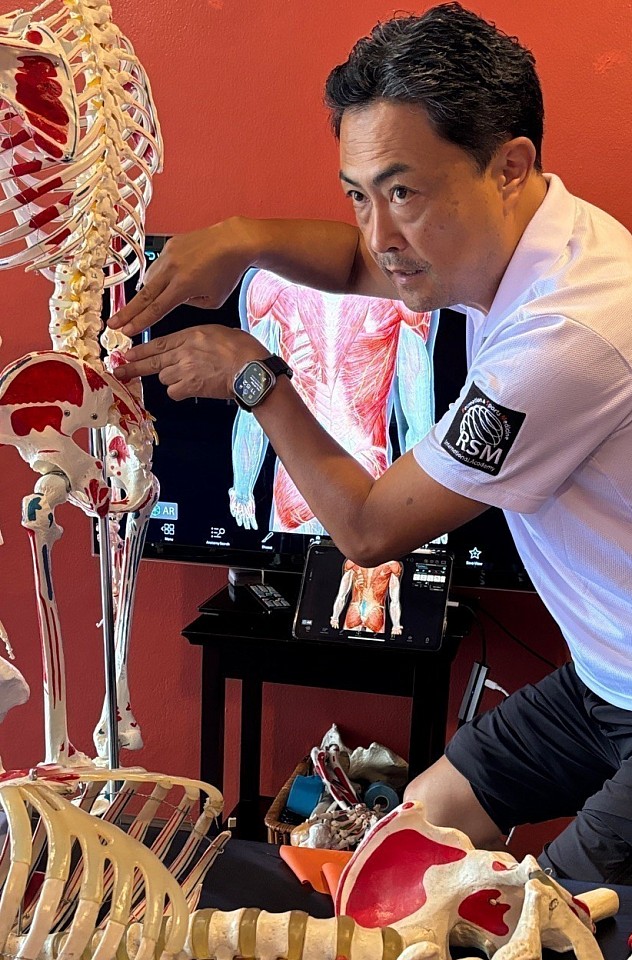
When I saw the title "Orthopedic Massage for Spine Mobility," I almost didn't sign up. As a beginner who had just finished the basic Trigger Point and Deep Tissue courses, the word "Orthopedic" sounded way too medical for me. I thought it was only for physiotherapists with years of experience. I was terrified I would be the only one in the room who didn't know what was going on.
I am so glad I ignored that fear. Hironori Ikeda (MSc Sports Medicine) has structured this course in a way that makes complex topics feel totally manageable, even if you are new to the industry.
It’s Not Just for Doctors
My biggest worry was that I wouldn't understand the anatomy. But the course provided a fantastic introduction to orthopedic assessment skills that started from the basics. We used hundreds of photos and diagrams to look at the spine segment by segment.
Instead of just memorizing Latin names, we learned practical anatomy knowledge for orthopedic massage. I finally understood how the rib cage connects to the hips and why breathing matters so much for back pain. It wasn't boring textbook stuff; it was visual and hands-on, which is exactly how I learn best.
A Roadmap for Treatment
Before this course, I often felt like I was just guessing during a massage. I would find a tight spot and rub it, hoping for the best. This training gave me actual structure. We learned developing treatment plans in orthopedic massage, which means I now know why I am doing a specific technique.
We studied real-life case studies in orthopedic massage therapy that showed us how to trace pain to its source. For example, seeing how a stiff upper back can cause lower back pain changed everything for me. Now, instead of just chasing symptoms, I have a plan.
Safe and Gentle Techniques
I was also worried that "orthopedic" meant aggressive cracking or popping joints. I was relieved to find that the orthopedic massage techniques we learned are actually very gentle. We focused on "LVLA" (Low Velocity Low Amplitude) mobilization, which uses slow, rhythmic movements to open up stiff joints.
The instructor explained the role of fascia in orthopedic massage, showing us that if you release the soft tissue tension first, the joints move easily without force. This made me feel safe practicing on clients, knowing I wasn't going to hurt anyone.
Knowing What to Look For
The most valuable skill I walked away with was assessment. The course taught us specific assessment protocols used in orthopedic massage to check a client's posture and movement before we even put them on the table.
Being able to see a restriction in someone’s spine or breathing gave me a huge confidence boost. Even as a beginner, I can now explain to a client, "Here is where you are stuck, and here is how we are going to fix it."
The Verdict
The class had a mix of people, from yoga instructors to experienced physios, but I never felt left out. The hands-on practice was detailed, and the small class size meant I got plenty of help.
If you are a beginner and you want to learn orthopedic massage the right way, don't be scared of the title. This course gave me the skills to do serious work and the confidence to call myself a real therapist. It’s the best orthopedic massage training course to bridge the gap between "relaxation" and real results.